Need Help?




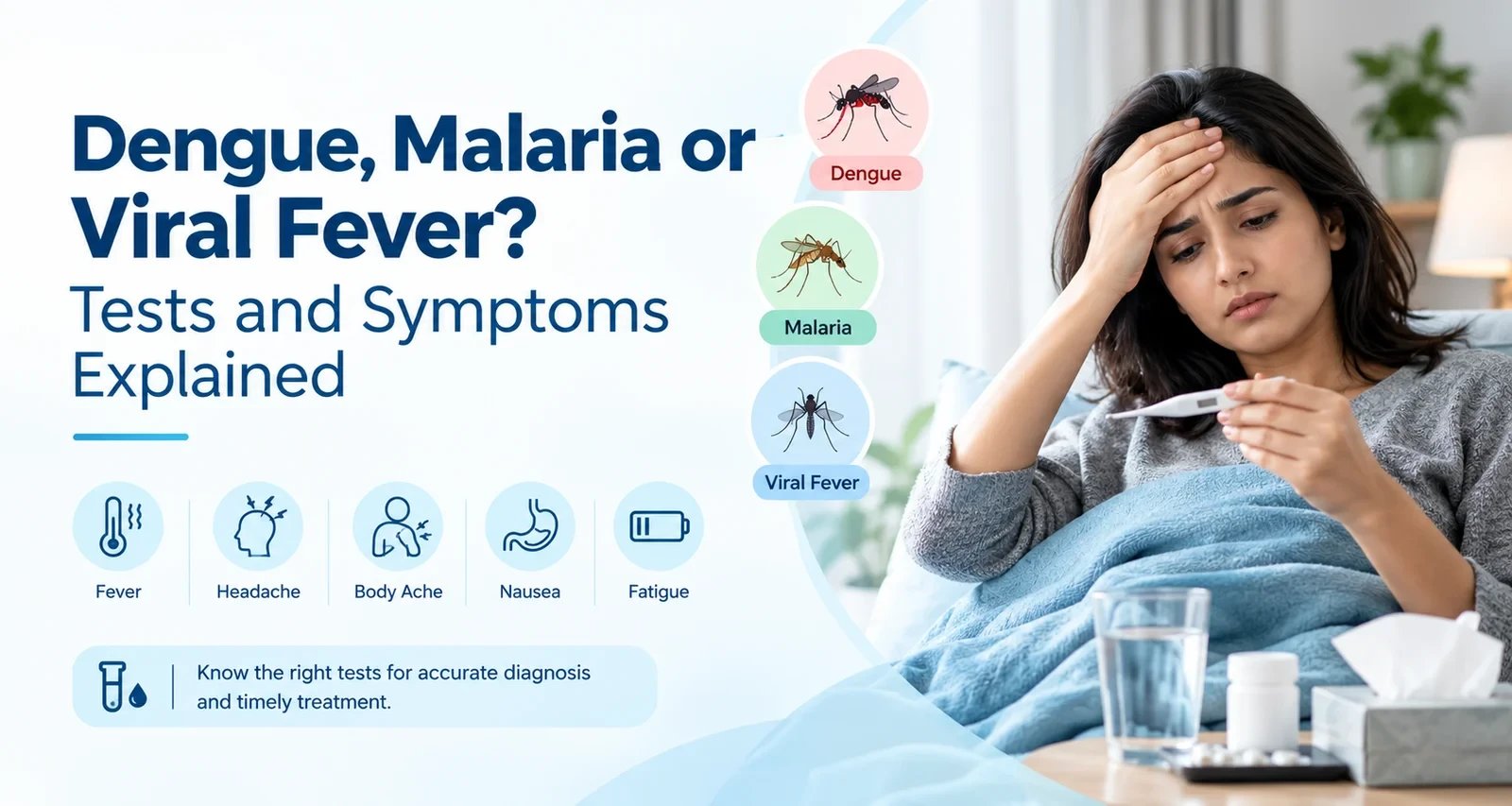
In the first look, dengue, malaria, and viral fever all look identical. Each one brings that same miserable mix of intense heat, body aches, and deep fatigue. But they are completely different illnesses. Treating the wrong one with the wrong pill won’t just slow down your recovery, but it can make things much worse.
Every single monsoon, this exact game plays out in homes across India. With hundreds of thousands of cases popping up year after year, families are left anxious and confused.
So, how do you tell them apart before things get serious? We’ve broken it down. In this guide, you’ll discover:
- The specific warning signs for dengue, malaria or viral fever.
- The exact blood tests needed to give you a clear, confident answer.
- The urgent red flags that mean it’s time to stop waiting and see a doctor.
What Is the Difference Between Dengue, Malaria and Viral Fever?
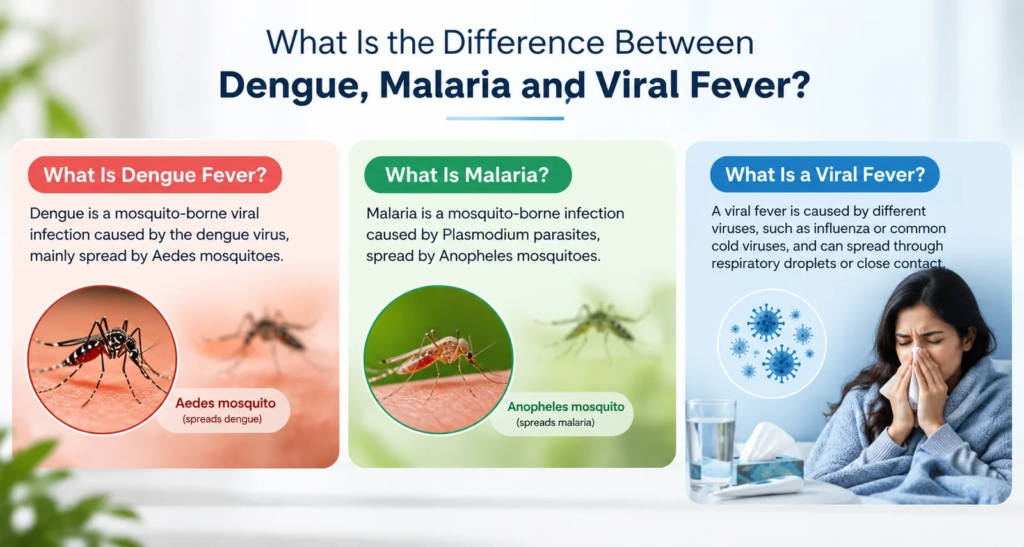
The source of the infection is where the three separate first actually. Everything else follows from that.
1. What Is Dengue Fever?
Dengue is a viral infection. The Aedes mosquito carries it. And it bites during daytime hours. So basically, dengue symptoms include a very high fever up to 40°C. Severe body and joint pain. A specific pain behind the eyes. Nausea and a rash also. The rash shows up 2 to 4 days after the fever starts. In serious cases, platelets drop sharply. Bleeding complications follow after that.
2. What Is Malaria?
Malaria is a parasitic infection. It is not viral. The Anopheles mosquito carries it. And it bites at night. Malaria symptoms follow a cycle. First you get chills. Then a spike in fever. Then heavy sweating as the temperature drops. Then a short stretch of normal before it all repeats. That cycle is the most specific thing about malaria.
3. What Is a Viral Fever?
Viral fever is not one disease. It is just what doctors call a fever caused by dozens of common viruses. So basically, viral fever symptoms are milder than dengue or malaria. For example, cough, runny nose, and sore throat often come alongside it. Body aches and fatigue are present. But they are much less intense than what dengue causes.
Also read: Dehydration in Senior Citizens
Dengue vs Malaria vs Viral Fever: Symptoms Compared
Malaria vs viral fever symptoms are nearly the same on day one, actually. Dengue is a bit different. Especially once the rash shows up. Or the platelet count starts falling. But that takes a few days. So basically, the table below helps until then.
Please note, it is a reference, not a diagnosis. For proper treatment and diagnosis, you can book our doctor checkup at home service, or visit your doctor in person.
| Feature | Dengue | Malaria | Viral Fever |
| Cause | Dengue virus, Aedes mosquito bites during the day | Plasmodium parasite, Anopheles mosquito bites at night | Common viruses like flu and cold viruses |
| Fever pattern | Sudden, high, stays between 102°F and 104°F | Fever comes in waves: chills, then high fever, then sweating | Mild to moderate, gets better in 3 to 7 days |
| Body and joint pain | Very bad, called breakbone pain, also pain behind the eyes | Moderate pain and tiredness | Mild body ache |
| Respiratory signs | Rare; nausea and vomiting more common | Rare; nausea and vomiting more common | Very common: cough, cold, sore throat |
| Skin rash | Shows up a few days after fever starts | Rare | Sometimes |
| Platelet count | Falls quite a bit | Normal or a bit low | Normal |
The problem is that on day one, dengue and viral fever symptoms show almost the same picture on this table. The rash is not there yet. The platelets have not fallen yet. So the table does not help at that point. A blood test is the only thing you need to go for.
Which Tests Confirm Dengue, Malaria or Viral Fever?
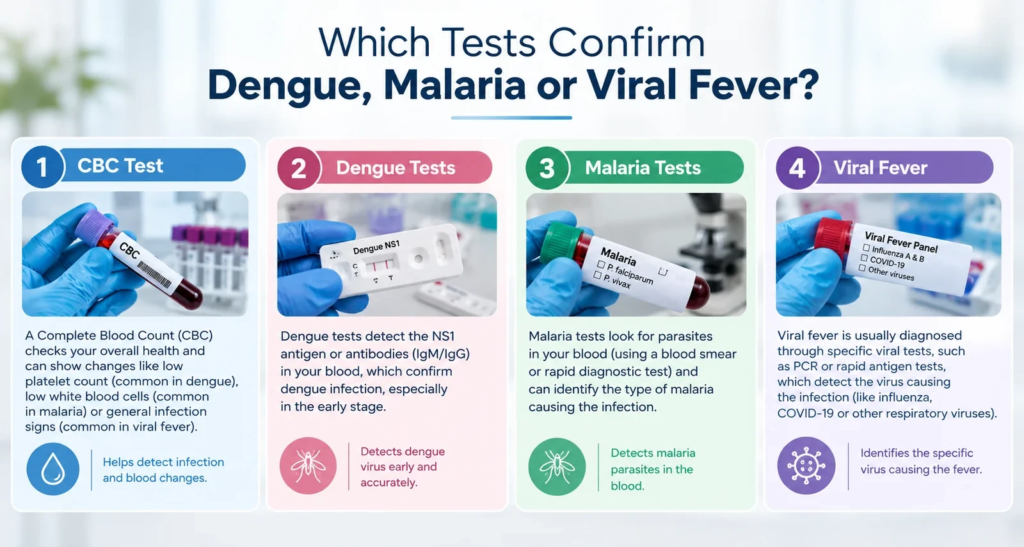
The dengue and malaria test choice depends on how many days the fever has been running. The wrong test on the wrong day will not show anything useful. A doctor checkup at home can figure out the timing and decide what to order before the sample goes to the lab.
CBC Test: Every fever case starts with a CBC. It checks the platelet count, white blood cells, and red blood cells. A falling platelet count with low white blood cells is a strong sign of dengue. But on day one or two, the CBC can read normal even in a dengue case. The picture gets clearer over 2 to 3 days. So one reading does not tell the whole story.
Dengue Tests: This is where timing matters the most. The NS1 antigen test works in the first 1 to 5 days of the fever. It looks for the dengue virus directly in the blood. After day 5, it stops being reliable. The IgM and IgG tests take over from around day 4 or 5 because by then the body has started making antibodies. Order the NS1 too late, or the antibody test too early, and the result will not reflect the actual situation.
Malaria Tests: The malaria RDT is a quick test done on a small blood sample. It checks for signs of the malaria parasite. It gives results fast. The blood smear test goes deeper. The lab looks at the blood under a microscope. Just to identify which type of malaria it is. And how much of the parasite is in the blood. So, when the first test comes back negative. But the fever pattern still points toward malaria. The doctor will ask for a repeat. And blood testing services at home collect both samples without the patient going anywhere.
Viral Fever: No single test can confirm every viral fever. The CBC gives a sense of how severe the illness is actually. From there, the doctor rules out dengue, malaria, and typhoid one by one. What gets tested depends on what the doctor finds during the checkup. It is not a fixed list for every fever. So, viral fever symptoms do not get better in 5 to 7 days. They need another checkup.
Dengue Malaria Treatment and What Not to Take
Please remember, ibuprofen, aspirin, and naproxen should not be taken. Especially when dengue is even a possibility. Because all three raise the bleeding risk. In dengue, the platelet count is already going down. So adding a medicine that makes bleeding more likely is dangerous. Of course, paracetamol at the dose the doctor gives is the safe option. For fever and body pain. Until the test result comes.
The test should come before the treatment. Because dengue symptoms and malaria symptoms overlap enough. So assuming based on what the patient describes is not enough. A fever panel with CBC, malaria smear, and dengue NS1 gives the actual condition. And when the patient is too unwell to go to a clinic. A home doctor visit or emergency critical care services at home is what we recommend.
Also read: Scrub Typhus in Jaipur
Dengue, Malaria or Viral Fever: Warning Signs that Cannot Wait
See, warning signs mean the illness has entered a dangerous phase. Home management cannot manage these in the first place.
- Severe stomach pain or tenderness that is not from hunger.
- Vomiting that will not stop. Even with only water.
- Bleeding from the nose or gums. Or blood in vomit or stool.
- Fast and labored breathing.
- Sudden disorientation or unusual drowsiness. Or loss of consciousness.
- Skin that turns pale, cold, and clammy.
- Very little or no urine over many hours.
And here is the thing families get badly wrong. A falling fever is not recovery, actually. In dengue specifically, warning signs appear exactly when the temperature drops. The critical phase begins as the fever goes down. So, watching less carefully because the fever broke is the mistake that ends badly.
When any of these appear. Emergency critical care services at home under a trained medical team can cover the situation. But severe warning signs need hospital admission first.
How to Care for Dengue, Malaria or Viral Fever at Home
No matter what, home care is one of the best things. And in many cases, patients recover very fast at home rather than at a hospital.
Dengue and malaria treatment follows two completely different protocols.
- Malaria requires prescribed antimalarial medicines. Started the same day the infection is confirmed.
- Dengue has no specific antiviral drug, actually. Dengue care is just fluids, rest, and close monitoring.
With paracetamol for fever in the dose the doctor prescribes. Aspirin and ibuprofen are dangerous in dengue. Because both raise the risk. So no self-medication with either of them.
The patient should drink water, coconut water, ORS solution, and light soups throughout the day. Not only when thirsty. But on a schedule.
Temperature should be recorded twice a day. Urine output and fluid intake should be noted also. Any new symptom should go into the same record. Because that record is what the treating doctor reads before making any decision.
So basically, 24-hour nursing care at home from a trained nurse builds that record properly. And catches changes the family might miss between check-ins. And when medical equipment & medicine are part of the at-home plan, trained staff manage them correctly.
Who Needs Extra Care During a Fever?
Children: Children under five cannot describe symptoms as we do as adults. And their fever can change fast.
Elderly Parents: Elderly patients have weaker responses to infection. And more conditions running in the background. So, elder health care services at home give elderly patients structured daily monitoring, without hospital trips for every check-in.
Pregnant Women: Pregnant women face added complications from both dengue and malaria. People with diabetes, heart conditions, or kidney problems. They need their doctor’s guidance adjusted throughout the illness.
People Living Alone: Any patient living alone needs someone present. A 24-hour bedside attendant who stays overnight covers the gap. Particularly during the critical phase of dengue. When warning signs appear as the fever drops. And no one is watching.
HomeCare24: Supporting Fever Recovery at Home
HomeCare24 provides home healthcare for patients recovering from dengue, malaria, and viral fever across India. We have trained nurses, bedside attendants, and doctors who visit at home.
You can arrange 24-hour nursing care at home, at-home doctor checkups, blood testing with home sample collection, and bedside attendant support through HomeCare24. Every care plan follows the treating doctor’s prescriptions. The team executes the plan.
If you are searching for home health care services near me, you can contact HomeCare24 to arrange the right support today.
FAQs: Dengue, Malaria or Viral Fever
1. How do you know if it’s viral fever or dengue?
You do not know without a test. Dengue has higher fever, pain behind the eyes, and a rash. Viral fever is milder, with a cough or cold. A blood test is the only confirmation.
2. How do I know if I have ma88laria or dengue?
Malaria fever cycles with chills and sweating. Dengue is constant and very high with intense body pain. A blood smear confirms malaria. An NS1 test confirms dengue. Both need a sample.
3. Which organ is affected by dengue?
The liver, blood vessels, and platelets. Platelet count drops, sometimes very sharply. In serious cases, bleeding complications need hospital-level care.
4. What are the 7 warning signs of dengue?
Severe stomach pain, constant vomiting, bleeding from the nose or gums, blood in stool or vomit, fast breathing, extreme drowsiness or disorientation, and cold, clammy skin. Any one of these means go to the hospital now.
5. When should I go to the hospital for a fever?
You should go to the hospital right away if any dengue warning sign appears, if the patient cannot keep fluids down, if the fever does not respond to paracetamol, or if disorientation develops. Do not wait for morning.