Need Help?



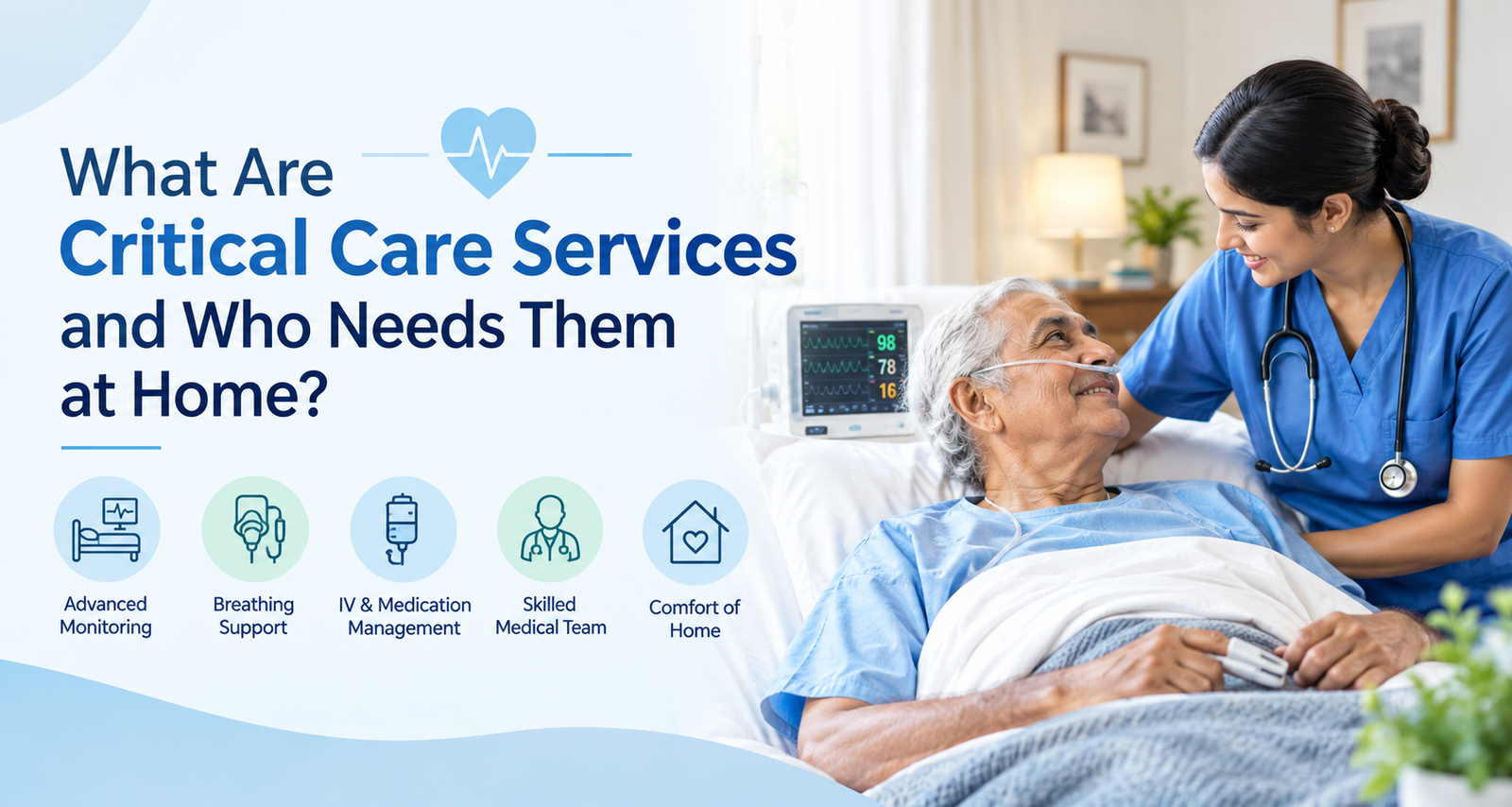
Critical care services are for patients who came out of the ICU but still need someone watching them round the clock. The hospital said stable enough to go home. But the family knows the patient is on oxygen. And needs vitals checked every few hours. Most importantly, he or she cannot be left alone at night.
This is exactly what our critical care services at HomeCare24 tackle. We send ICU-trained nurses, set up the right medical equipment for home care, and coordinate with the treating doctor. The patient gets hospital-level attention at home. The family gets some peace of mind.
Let’s learn more about critical care services and why you should consider them at home.
What Are Critical Care Services?
Critical care services means continuous medical monitoring for patients with serious conditions. It is not just a nurse who visits twice a day. It is an ICU-trained nurse who is there through the shift, managing equipment, tracking vitals, and handling whatever comes up.
According to IMARC Group, India’s home healthcare market was valued at USD 16.30 billion in 2025 and is projected to reach USD 74.57 billion by 2034. A big part of this growth is coming from families choosing medical home care services for critical patients rather than keeping them in the hospital longer than needed.
One thing to be clear about. Home-based critical care is for stabilised patients only. A patient who is still deteriorating or hemodynamically unstable needs to stay in the hospital ICU. We are honest about this when families call.
Critical Care at Home vs Hospital ICU
A hospital ICU and home-based critical care are not competing options. They serve different stages of a patient’s condition. The ICU handles the acute phase. Home critical care handles what comes after, when the patient is stable but still needs a trained nurse, working equipment, and someone who knows what to do if something changes at 3 am. The table below shows where each one is the right choice.
| Factor | Critical Care at Home | Hospital ICU |
| Environment | Patient’s own home | Hospital ward |
| Nurse Attention | One nurse, one patient | One nurse, multiple patients |
| Equipment | Medical equipment for home care set up on-site | Available on-site |
| Ventilator Support | Ventilator support ICU hospital level at home | Available on-site |
| Infection Risk | Lower, controlled environment | Higher, hospital-acquired infections |
| Family Access | Family present any time | Restricted visiting hours |
| Cost | Lower for long-term stable cases | Higher for extended admission |
| Right For | Stabilised patients needing monitoring | Acute and deteriorating patients |
What Do Critical Care Services at Home Cover?
Everything a stabilised critical patient needs at home to stay safe without going back to hospital.
| Service | What It Covers |
| Ventilator Support ICU Hospital Level | BiPAP, CPAP, mechanical ventilator management |
| Tracheostomy Tube Care at Home | Airway suctioning, tube changes, infection check |
| Home Nursing Services | ICU-trained nurses on 12-hour or 24-hour shifts |
| 24 Hours Bedside Attendant | Personal care and continuous patient monitoring |
| Medical Equipment for Home Care | Oxygen concentrators, suction machines, hospital beds |
| Diagnostic Healthcare Services | Blood tests, ABG monitoring, reports at home |
| Home Care Doctor Visit | Physician visits and care plan updates at home |
| Emergency Critical Care Services | Rapid response and hospital transfer coordination |
| Health Care Assistance | IV therapy, medications, wound care, feeding support |
| Critical Care Ambulance Services | Safe medically supervised hospital-to-home transfer |
Who Needs Critical Care Services at Home?
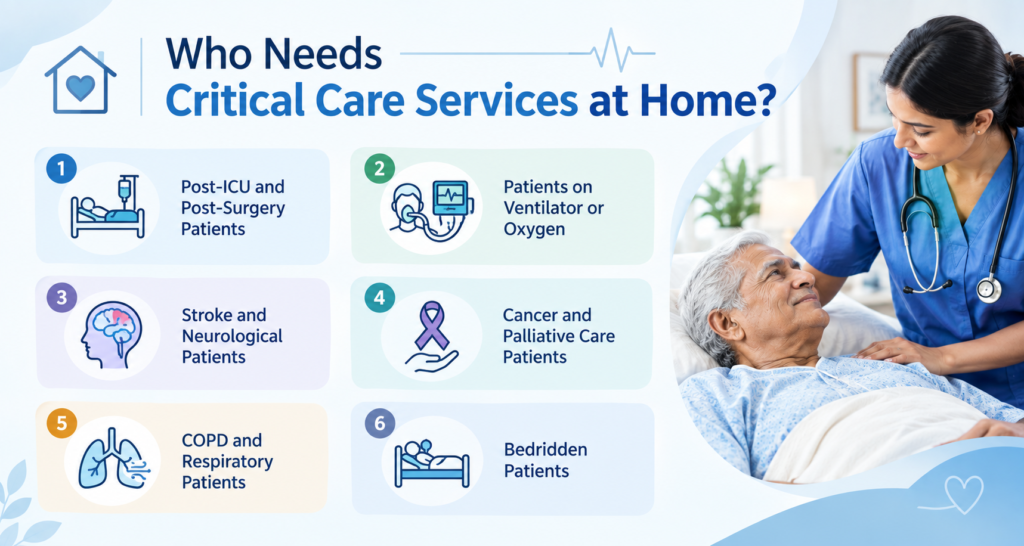
1. Post-ICU and Post-Surgery Patients
A patient who came home after cardiac surgery, brain surgery, or a major trauma still needs close attention every day. The vitals need checking multiple times a day. The wound care cannot be ignored at any condition. The medicines have to go in on a strict schedule. A basic attendant is not qualified to handle any of this. An ICU-trained nurse is.
2. Patients on Ventilator or Oxygen
This is one of the most serious home care situations. The nurse has to know how to manage the ventilator, respond to alarms, and act fast if something changes. Our emergency critical care services include ventilator management as part of every setup.
3. Stroke and Neurological Patients
A stroke patient at home needs position changes every two hours to prevent pressure ulcers. The nurse handles neurological monitoring throughout the entire shift. The physiotherapy schedule also needs coordination with the treating team. And for patients who also need tracheostomy tube care at home on top of all this, the nursing qualification requirement goes up further.
4. Cancer and Palliative Care Patients
In a critical disease like cancer, the patient wants to be home and every single treatment at home, if possible. For example: pain management, IV medications, tube feeding or more. In this case, a health care assistance at this stage is about comfort and clinical support together.
5. COPD and Respiratory Patients
A patient with severe COPD or chronic respiratory failure needs long-term oxygen therapy, daily saturation monitoring, and a strict medicine schedule every single day. A trained nurse at home with the right medical equipment for home care handles all of this without the patient needing to go anywhere.
6. Bedridden Patients
A bedridden patient cannot move on their own, cannot eat independently, and cannot manage personal hygiene without help. This patient needs a 24-hours bedside attendant alongside a qualified nurse. Both roles together cover the medical monitoring and the daily personal care so the family is not carrying everything on their own.
How Much Does Critical Care at Home Cost?
There is no fixed rate. The cost depends on the patient’s situation and the treatment they need.
What changes the cost:
- ICU nurse versus basic trained nurse
- Whether ventilator support ICU hospital-level equipment is part of the setup
- 12-hour or 24-hour nursing shifts
- Whether tracheostomy tube care at home is needed
- Whether critical care ambulance services are required for the hospital transfer
- Whether diagnostic healthcare services and home care doctor visit are included
- How long the care plan runs
For a better understanding, you may call us with the patient’s discharge summary. We will give you an estimated or fixed cost accordingly.
Also read: Arrange Before Bringing a Patient Home From the Hospital
When Should a Family Consider Critical Care at Home?
A family should consider critical care services at home in these conditions. For example, call us for critical care near me when:
- The patient is discharged from ICU but still needs round-the-clock monitoring
- The patient is on a ventilator, BiPAP, or oxygen concentrator at home
- The patient needs tracheostomy tube care at home after a procedure
- The patient needs a 24-hours bedside attendant through the night
- The patient is in the palliative stage and wants to be home
- The family needs critical care ambulance services for a safe hospital-to-home move
Why HomeCare24 for Critical Care Services?
HomeCare24 is one of the best medical home care service providers in jaipur. Being a leader in this domain, we do not assign anyone before doing a home assessment. The patient’s discharge summary, current condition, equipment needed, and the doctor’s instructions are all reviewed first.
How we start:
- You call us with the patient’s situation
- We do a home assessment at the patient’s location
- We match an ICU-trained nurse to the specific condition
- Medical equipment for home care is set up before care begins
- Daily updates go to the family and the treating doctor
We offer so many services, for example, home nursing services with ICU-trained nurses, 24 hours bedside attendant support, ventilator management, tracheostomy tube care at home, emergency critical care services, home care doctor visit coordination, diagnostic healthcare services at home, and medical home care services across Jaipur and surrounding areas.
If the patient’s condition changes, the plan changes. We do not lock families in. And we tell you if home critical care is not the right option for the patient.
FAQs About Home Critical Care Services
1. What are critical care services at home?
Critical care services are like the ICU coming to your home. A trained nurse is there through the shift. The right medical equipment for home care is set up at the patient’s location. The doctor stays in the loop. The patient gets proper monitoring without going back to the hospital.
2. Who needs critical care services at home?
A patient who just came out of the ICU. Someone on a ventilator or oxygen at home. A stroke patient who needs round-the-clock attention. A cancer patient in the palliative stage who wants to be home. A bedridden patient who needs a 24 hours bedside attendant alongside a nurse.
3. Is home critical care as safe as a hospital ICU?
For a stabilised patient, yes. The nurse is ICU-trained. The equipment is the same. The emergency critical care services backup and hospital transfer protocol are already in place.
4. How soon can critical care services start at home?
Once the home assessment is done and the care plan is confirmed, we can start within 24 to 48 hours. If the situation is urgent, just say so when you call. We help faster in those cases.
5. What is tracheostomy tube care at home?
It is airway management for patients who have a tracheostomy tube in place. The nurse suctions the airway, cleans the tube, changes it on schedule, and monitors for infection.
6. How do I find critical care near me?
Start by checking whether the provider has ICU-trained nurses and proper medical equipment setup. Then ask about emergency critical care services and what the hospital transfer protocol looks like. And before anyone is assigned, make sure a home assessment is done first.