 Need Help?




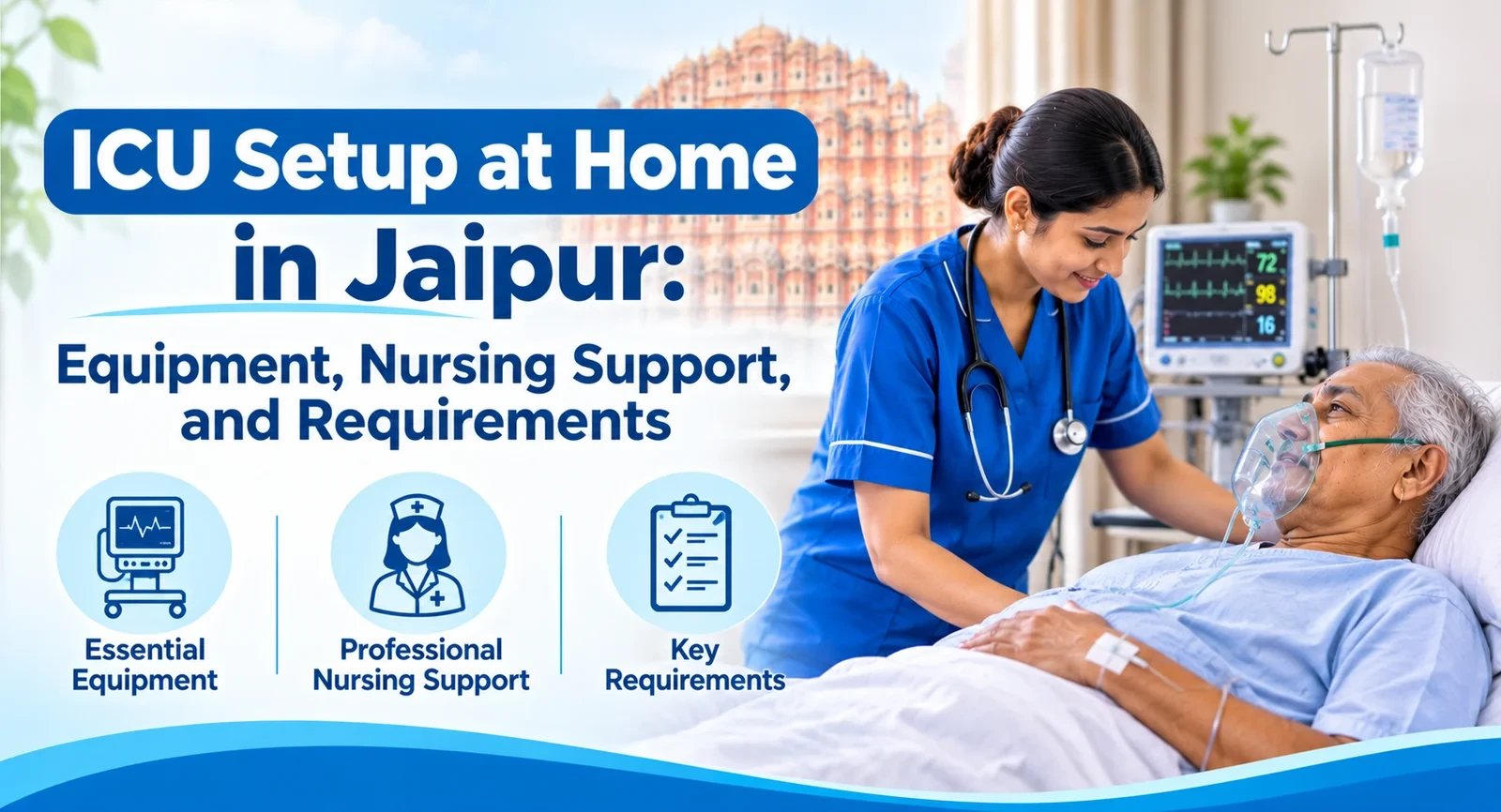
When someone comes back from the ICU, stable does not mean okay. It means it’s okay enough to leave. The ventilator is still running. The feeding tube is still in. The monitoring cannot stop. And you are at home with none of that, trying to figure out what happens next.
That is when ICU setup at home in Jaipur becomes the only solution that makes sense. A trained team comes to your home with the equipment, sets it up, and takes over the nursing. The patient does not go back to the hospital. You stop paying for an inpatient bed your patient does not need anymore.
Today, we are going to see what equipment is required, what the nursing team does, and how the whole setup works. And if you need critical care services arranged at home in Jaipur today, that can be done at your door.
What Is an ICU Setup at Home?
An ICU setup at home just brings the hospital room straight into your house. You get the monitors, the machines, and the clinical support, but the patient stays right in their own room.
Note that this service is not for everyone. It is strictly for patients who are out of actual danger, but still totally rely on heavy medical machines or constant nursing care. The kind of support a family simply cannot do alone.
The setup brings in the exact medical equipment the patient needs. A trained nursing team takes over the clock in shifts. A doctor regularly checks in to track the healing.
If done right, the patient gets strict hospital-level attention. But you completely avoid the massive daily bed charges and those dangerous ward infections. They just get to recover where they feel safe.
Who Needs an ICU Setup at Home in Jaipur?
Not everyone leaving the hospital needs a full medical room. But for some families, an ICU setup at home in Jaipur is literally the only safe option left. Here is who really needs one:
- Patients still rely entirely on a ventilator to breathe after coming home.
- Patients with a breathing tube (tracheostomy) who constantly need suctioning and clear airways.
- Stroke survivors who require strict monitoring and good nursing backup.
- Terminally ill patients who simply want to spend their final days resting around family.
- Patients who survived a massive surgery but still need a professional watching them closely.
- Older patients fighting multiple diseases who just cannot survive without clinical help.
Hospitals stress older people out. Keeping them in a loud ward after they stabilize slows down healing. Blending elder health care services at home with actual critical care simply keeps them calm. And a calm patient always recovers faster.
Also read: 12-Hour vs. 24-Hour Home Care Services in Jaipur
Equipment Required for ICU Setup at Home in Jaipur
The equipment depends entirely on the patient’s condition. What a ventilator-dependent patient needs is different from what a post-stroke patient needs. A doctor must assess the patient before any equipment is arranged.
| Equipment | Purpose |
| Hospital bed with pressure mattress | Prevents bedsores in bedridden patients |
| Ventilator or BiPAP/CPAP machine | Breathing support for respiratory patients |
| Oxygen cylinder or concentrator | Supplemental oxygen when required |
| Pulse oximeter | Continuous oxygen saturation monitoring |
| Cardiac monitor | Heart rate and rhythm tracking |
| Suction machine | Airway clearance for tracheostomy patients |
| Infusion pump | Controlled IV medication delivery |
| Nasogastric feeding equipment | Nutrition for patients who cannot eat orally |
| Urinary catheter supplies | For bedridden patients who cannot manage independently |
| Emergency drug kit | Critical medications accessible at all times |
All of this comes under medical equipment and medicine arranged at home. The equipment is set up by trained staff. And everything is checked before the patient arrives or as part of the initial home assessment.
Critical Care Nursing at Home: What the Nursing Team Does
The equipment is only half of it. Without the right nursing team, a home ICU is just machines in a room. Nobody is watching them. Nobody acts when a number changes. That is the part that keeps the patient safe.
The nursing team, for example, manages everything the patient cannot manage alone:
- Continuous vital monitoring (oxygen levels, heart rate, blood pressure, temperature) through the full shift.
- Ventilator care at home including circuit checks, settings monitoring, and airway management for patients on respiratory support.
- Tracheostomy care (suctioning, tube cleaning, infection prevention) done on schedule.
- Wound dressing, IV line management, and catheter care.
- Medicines given exactly as prescribed, on time, with the right dosage.
- Feeding through nasogastric or PEG tubes for patients who cannot eat on their own.
- Turning and repositioning bedridden patients to stop pressure sores from forming.
- Calling the doctor immediately when any reading goes outside the safe range, not waiting to see if it settles.
For daily personal care alongside the nurse, a home attendant for patients takes care of bathing and feeding support. And other basic help so the nurse stays focused on clinical work. And if the patient needs a doctor to come and assess in person, a home care doctor visit can be arranged the same day.
One thing worth checking before you book anyone. Home nursing services at this level need ICU-trained nurses, You should not hire any general staff.
When Is Home ICU Setup the Right Choice?
Home ICU is not for any patient who is serious. It is for one specific situation. The patient is stable enough to leave the hospital but still needs machines, monitoring, or nursing support that the family cannot provide on their own.
The right patient for home ICU looks like this:
- Hospital has cleared them for discharge
- They are still on a ventilator, oxygen, or need continuous monitoring
- The family cannot manage the clinical side on their own
- The condition is not expected to change fast without warning
- The patient wants to be home, not in a facility
Home ICU is not for active emergencies. If the patient is deteriorating fast, if they might need surgery at any moment, and if resuscitation is a possibility, that is a hospital situation. For situations that develop without warning at home, emergency critical care services can be arranged the same day. But that is rapid response support. Keep in mind that is not a replacement for a hospital in a crisis.
Read more: Top 10 Home Care Agencies in Jaipur
HomeCare24: Critical Care Services at Home in Jaipur
Setting up an ICU at home is not something a family should figure out on their own. The wrong equipment, an undertrained nurse, or a delayed response to a change in the patient’s condition can turn a manageable situation into a crisis.
HomeCare24 is a Jaipur-based home care team with 5+ years of experience and 500+ families served, available 24/7 including weekends and public holidays. We arrange ICU setup at home in Jaipur with trained critical care staff, the right medical equipment, and a dedicated coordinator who stays in contact with the family throughout.
HomeCare24 provides these services at your home in Jaipur:
- Critical care services
- Medical equipment & medicine
- Home nursing services
- Home attendant for patient
- Home care doctor visit
- Elder health care services
Every nurse we send has either a GNM or B.Sc. nursing degree. We check the background of every caregiver before they step into your home. And one person from our team stays connected with your family throughout, from the day you call to the daily updates during care.
Call +91-8003888100 or visit homecare24.in and tell us about your patient. We will take it from there.
FAQs: ICU Setup at Home in Jaipur
1. What is an ICU setup at home in Jaipur?
ICU setup at home in Jaipur means arranging the medical equipment, nursing team, and clinical monitoring a stable critical patient needs inside their own home, so they can continue recovering without staying in a hospital.
2. Which patients need home ICU setup?
Patients who are stable but still ventilator-dependent, have a tracheostomy, need continuous monitoring, or cannot safely manage without round-the-clock clinical support are the ones who need a home ICU setup.
3. What equipment is needed for an ICU at home?
Equipment for home ICU includes a hospital bed with pressure mattress, ventilator or BiPAP, oxygen supply, cardiac monitor, pulse oximeter, suction machine, infusion pump, and feeding supplies depending on the patient’s condition.
4. Is home ICU setup safe for critical patients?
Home ICU setup is safe for patients who are medically stable and whose condition is not expected to change rapidly. It is not appropriate for patients in an active emergency or those who may need immediate surgical intervention.
5. How many nurses are needed for a home ICU in Jaipur?
Critical care nursing at home requires at least one ICU-trained nurse per shift, with two shifts covering the full 24 hours. The number of nurses depends on how clinically complex the patient’s needs are.


