Need Help?



Knee replacement surgery can alleviate severe knee pain and restore its mobility, but the surgical intervention is only part of the story. Physiotherapy after knee replacement contributes significantly to the knee’s recovery, restoration of muscle function, balance, and return to normal activities.
For many, the physiotherapy treatment at home following knee replacement surgery is often more comfortable than in-clinic treatments. A physiotherapist will guide you through a set of individually selected therapeutic exercises, help control your mobility, and coordinate your further recovery.
Since people often differ considerably in age, level of fitness, and a number of other factors, the main difficulties during rehabilitation, possible mistakes, and principles of recovery will be discussed weekly. In addition, the course includes recommendations on exercises, mobility tests, and when to call a doctor.
Why Is Physiotherapy Important After Knee Replacement?
After knee replacement, the muscles around the operated leg may be weak, and the knee can feel stiff or uncomfortable. Physiotherapy helps the patient gradually regain movement and confidence without placing unnecessary stress on the healing joint.
A personalized rehabilitation program can help:
- Restore knee movement and flexibility.
- Improve thigh and leg strength.
- Reduce stiffness caused by limited movement.
- Improve balance and walking ability.
- Practice safe transfers, such as getting up from a chair.
- Build confidence with everyday movements.
- Support a gradual return to normal activities.
The goal is not simply to exercise more. The goal is to perform the right exercises at the right stage of recovery, based on professional assessment and the patient’s response.
Benefits of Physiotherapy at Home After Knee Replacement
Home-based rehabilitation can be particularly useful during the first few weeks after discharge.
With physiotherapy at home in Jaipur or another nearby location, patients may benefit from:
- Recovery in a familiar and comfortable environment
- Less travel immediately after surgery
- One-on-one exercise guidance
- Exercises adapted to the patient’s mobility and strength
- Easier involvement of family members or caregivers
- Regular monitoring of functional progress
- Rehabilitation that fits into the patient’s daily routine
Home sessions can also be useful when a patient has difficulty travelling because of pain, limited mobility, or the need for additional home support services.
Knee Replacement Recovery: What to Expect Week by Week
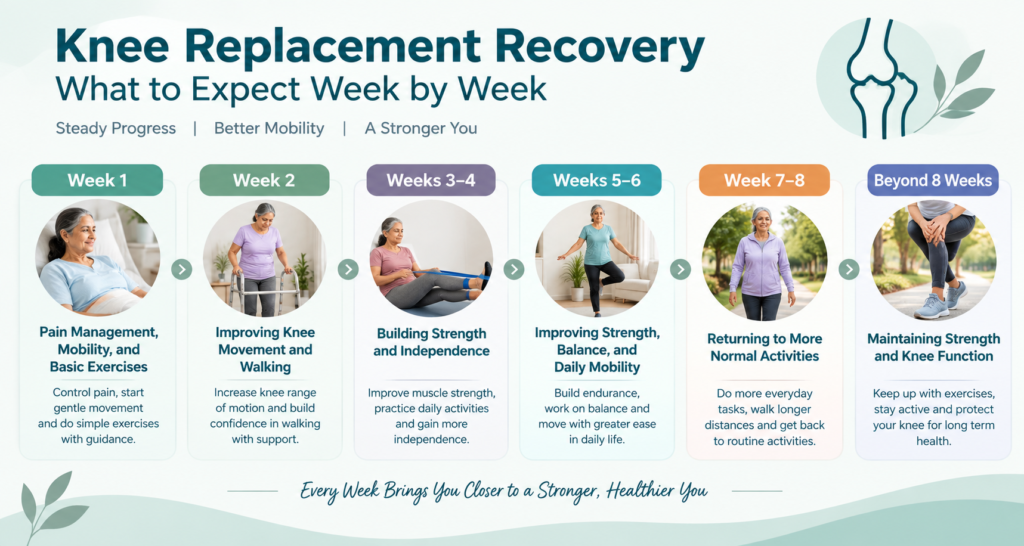 The following timeline provides general rehabilitation goals rather than strict deadlines. Your surgeon and physiotherapist may modify exercises, walking goals, and activity levels according to your condition.
Week 1: Pain Management, Mobility, and Basic Exercises
The first week focuses on safe movement, basic muscle activation, and preventing excessive stiffness. The patient may initially use a walker, crutches, or another prescribed walking aid.
Common goals include:
- Getting in and out of bed safely
- Standing with appropriate support
- Taking short, supervised walks
- Performing gentle knee movement exercises
- Doing ankle pumps
- Activating the quadriceps muscles
- Beginning gentle knee-bending exercises
- Practicing safe transfers between the bed, chair, and bathroom
Short, frequent walks are usually easier to manage than prolonged ones. The physiotherapist will also show the patient how to properly position the operated leg and use walking aids.
The patient may feel discomfort due to pain and swelling during the recovery process. It is important not to try to move too much and overexert the limb; instead, the rehabilitation course should be followed carefully and under the supervision of medical professionals.
Week 2: Improving Knee Movement and Walking
During the second week, rehabilitation usually focuses on gradually improving knee bending and straightening while increasing confidence with walking.
Depending on progress, therapy may include:
- Gradually increasing walking activity
- Continuing range-of-motion exercises
- Strengthening the thigh and calf muscles
- Practicing controlled sit-to-stand movements
- Improving transfers and basic mobility
- Continuing prescribed home exercises
There is no universal distance or exercise intensity that every patient should achieve in Week 2. Progress should depend on pain, swelling, strength, balance, and professional assessment.
If walking remains difficult, physical therapy home care can allow a physiotherapist to observe how the patient moves in their actual home environment and identify practical mobility challenges.
Weeks 3–4: Building Strength and Independence
By Weeks 3 and 4, many patients begin working more actively on strength, balance, and functional movement. However, recovery rates vary considerably.
A physiotherapist may introduce or progress:
- Leg-strengthening exercises
- Balance activities
- Sit-to-stand practice
- Walking technique
- Stair practice when appropriate
- Functional movements used in everyday life
- Gradually increased daily activity
Walking aids should not be removed simply because a patient wants to walk independently. The physiotherapist can determine when reducing reliance on a walker or other support is appropriate.
The focus during this stage is controlled movement rather than speed. Good technique can help patients develop safer and more confident movement patterns.
Weeks 5–6: Improving Strength, Balance, and Daily Mobility
Around Weeks 5 and 6, rehabilitation may become more functional as strength and mobility improve. Patients may be able to walk for longer periods and participate in more everyday activities, depending on their recovery.
Therapy may focus on:
- Progressive strengthening
- Improving knee flexibility
- Longer periods of walking
- Balance and coordination
- Functional exercises
- Controlled household activities
- Improving confidence during everyday movement
Not every patient will reach the same milestone at six weeks. Someone with other health conditions or slower healing may need more time, while another patient may progress faster.
The safest approach is to use functional ability and professional assessment—not a calendar alone—to determine when activities should be increased.
Weeks 7–8: Returning to More Normal Activities
During Weeks 7 and 8, rehabilitation often continues to build strength, endurance, balance, and confidence.
Depending on medical advice and individual progress, therapy may include:
- Continued strengthening exercises
- Endurance-building activities
- Functional movement training
- More confident walking
- Balance exercises
- Gradual return to suitable low-impact activities
- Continued home exercise practice
Improved mobility does not mean rehabilitation should stop. Consistent exercises can remain an important part of maintaining strength and knee function.
Beyond 8 Weeks: Maintaining Strength and Knee Function
Knee replacement rehabilitation can be continued after eight weeks. The recovery of strength, flexibility, coordination, and confidence may be prolonged.
Patients are nonetheless advised to continue the treatment regimen as directed by their surgeons and physiotherapists. Maintenance exercises are also needed to ensure that it is safe for them to resume more strenuous activities.
As for the most effective long-term program, it should be individualized according to the patient’s particular case, preferences, and functional needs.
Common Physiotherapy Exercises After Knee Replacement
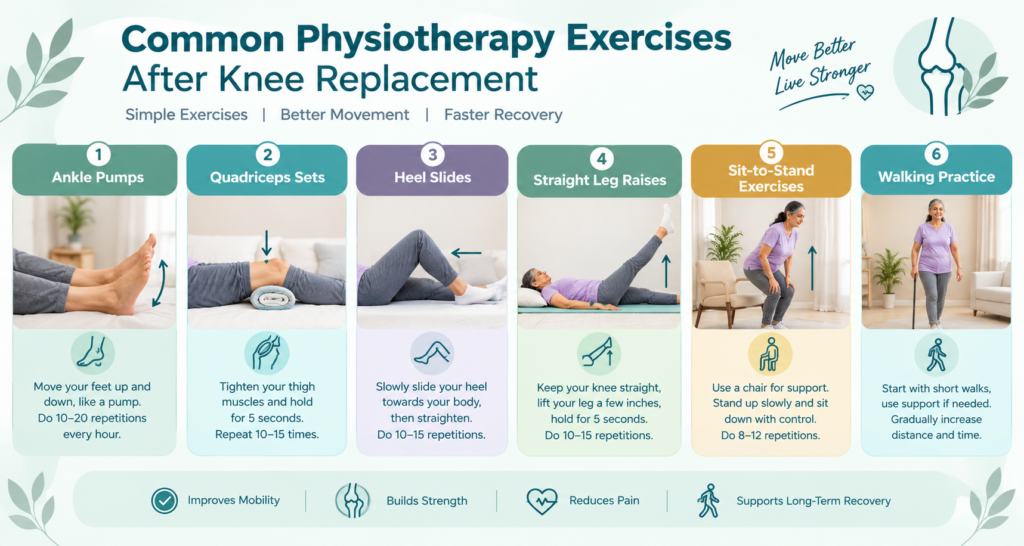 Exercises after knee replacement should be selected according to the patient’s individual rehabilitation plan. A physiotherapist can demonstrate the correct technique and modify exercises when pain, weakness, or mobility limitations affect performance.
1. Ankle Pumps
Ankle pumps involve gently moving the foot up and down while the leg is supported. They encourage regular ankle movement and are commonly included in early mobility programmes.
2. Quadriceps Sets
Quadriceps sets involve gently tightening the thigh muscles while keeping the leg positioned as instructed. They help activate the quadriceps, an important muscle group for standing, walking, and knee stability.
3. Heel Slides
Heel slides involve gradually sliding the heel toward the body and then returning the leg to a straighter position, within the recommended range. They are commonly used to work on knee flexibility and controlled movement.
4. Straight Leg Raises
Straight leg raises can help strengthen the muscles supporting the leg when the patient can perform the movement safely. Proper technique is important, and the exercise should only be performed when recommended by the physiotherapist.
5. Sit-to-Stand Exercises
Practicing standing up and sitting down in a controlled manner helps develop functional leg strength. It can also improve confidence with everyday movements such as getting up from a chair.
6. Walking Practice
Walking is an important part of knee replacement rehabilitation. A physiotherapist can assess gait, posture, walking-aid use, balance, and weight-bearing ability, then gradually adjust walking activity according to recovery.
Read more: What to Arrange Before Bringing a Patient Home From the Hospital
When Should You Have Physiotherapy at Home After Knee Replacement?
Physiotherapy may start soon after the operation, depending on the advice of the surgeon and the individual’s condition. Usually it is about getting them up and about doing some simple exercises, transfers, and walking properly.
It can be very useful for those who find it hard to get out and about to have a therapist come to their home to help them. It helps them to have one-on-one help and is able to change the program as they get better and more mobile.
The frequency of sessions depends on factors such as
- Current mobility
- Pain and swelling
- Muscle strength
- Balance
- Ability to perform exercises independently
- Overall health
- Progress during rehabilitation
There is no single number of sessions that is appropriate for every patient. Your healthcare team should determine the rehabilitation plan based on your individual needs.
If additional assistance is required, families may also consider related medical home care services, patient support, or patient caretaker services while the patient regains independence.
Signs You May Need to Contact Your Doctor
Some discomfort, stiffness, and swelling can occur during normal recovery. However, symptoms that are severe, worsening, sudden, or unusual should not be ignored.
Contact your doctor or seek appropriate medical assessment if you experience:
- Increasing or severe pain
- Significant or worsening swelling
- Fever or chills
- Redness or drainage around the surgical incision
- Sudden difficulty walking or bearing weight
- New or significant calf pain or swelling
- Chest pain
- Breathing difficulty
Chest pain or sudden breathing difficulty can require urgent medical attention. Do not assume that concerning symptoms are simply part of physiotherapy or normal surgical recovery.
How Home Physiotherapy Can Support Knee Replacement Recovery
Home-based rehabilitation can make recovery easier for patients who are not yet comfortable travelling to a clinic. A professional physiotherapist can work directly with the patient and adapt the program as their condition changes.
Home physiotherapy may include:
- One-on-one physiotherapy sessions
- Personalized rehabilitation planning
- Exercise demonstrations and correction
- Walking and mobility assessment
- Progress monitoring
- Functional movement training
- Guidance for family members and caregivers
- Recommendations for safer movement around the home
For families managing multiple aspects of recovery, other services may also be relevant, such as home care equipment, routine health checkups, home care doctor visits, or 24-hour nursing care at home, depending on the patient’s needs.
For patients requiring more intensive support, 24-hour home care services or critical care support may be considered when clinically appropriate.
Why Choose HomeCare24 for Physiotherapy at Home?
HomeCare24 provides home-based healthcare support designed around the patient’s needs. For knee replacement recovery, home physiotherapy can offer convenient one-on-one assistance while the patient follows the rehabilitation recommendations provided by their healthcare team.
Support can include:
- Physiotherapy assistance at home
- Personalized exercise guidance
- Mobility and walking support
- Progress-focused rehabilitation
- Caregiver guidance
- Convenient sessions without frequent clinic travel
For families looking for physiotherapy near me, home-based care can be a practical option when travelling is difficult during the early stages of recovery. HomeCare24 can help patients access physiotherapy support in a familiar environment while keeping their existing medical recommendations at the center of care.
Also read: Why Choose HomeCare24 for Home Care Services in India
Key Takeaway: Supporting a Safe Knee Replacement Recovery at Home
Physiotherapy after knee replacement is the process of recovering movement and strength of the knee joint, improving balance, walking, and the overall functionality of the knee. Following a week-by-week plan is a helpful addition to any rehabilitation, but one must not rely on generic information only. Each person will undertake a slightly different physiotherapy course depending on how their knee heals.
Physiotherapy at home and the availability of professional help can make the post-surgery life easier by providing guidance, assistance, and advice. It is essential to consider the options and understand the rehabilitation process.
FAQs About Physiotherapy After Knee Replacement
1. How long does physiotherapy take after knee replacement?
Physiotherapy can continue for several weeks or longer depending on mobility, strength, flexibility, pain, general health, and individual goals. Some patients progress quickly, while others need extended rehabilitation. Your surgeon and physiotherapist should determine when exercises, supervised sessions, and rehabilitation goals can be reduced or changed.
2. Can physiotherapy be done at home after knee replacement?
Yes. Physiotherapy can be provided at home after knee replacement when appropriate. A physiotherapist can guide exercises, assess walking and mobility, practise functional movements, and adapt the rehabilitation plan. Home sessions can be particularly convenient during the early recovery period when travelling to a clinic is difficult.
3. When can I start walking normally after knee replacement?
Walking usually begins early in recovery, with the type and amount of support depending on the patient’s condition and surgical instructions. Walking normally takes time because strength, balance, knee movement, and confidence must improve. Your physiotherapist can guide progression from assisted walking toward greater independence.
4. How much should I walk after knee replacement?
There is no single walking distance suitable for every patient after knee replacement. Walking should generally increase gradually according to pain, swelling, strength, balance, and professional guidance. Short, manageable walks may be preferable early on. Follow your surgeon’s and physiotherapist’s recommendations rather than comparing your progress with others.
5. What exercises should be avoided after knee replacement?
Exercises that place excessive stress on the healing knee or conflict with your surgeon’s restrictions should be avoided. High-impact activities and movements performed with poor technique may be inappropriate during recovery. Do not add advanced exercises independently; ask your physiotherapist when a particular movement is safe for you.
6. Is home physiotherapy better than visiting a clinic after knee replacement?
Neither option is automatically better for every patient. Home physiotherapy can be especially convenient when pain or limited mobility makes travel difficult. Clinic-based rehabilitation may suit patients who can travel safely and need specific facilities. The best setting depends on medical needs, mobility, rehabilitation goals, and professional recommendations.