Need Help?




Bringing a patient with a tracheostomy tube back home can be challenging for families. The tracheostomy care at home requires that they keep the tracheostomy site clean, monitor the patency and secretion of the tube, adhere to a certain care regimen, and know when to seek professional medical assistance. These aspects of care can be facilitated if proper preparations are made, appropriate supplies are available, instructions are understood, and professional support is enlisted.
What Is Tracheostomy Care at Home?
Tracheostomy care at home refers to the range of services provided to a patient following a tracheostomy procedure that involves the placement of a breathing tube into the windpipe and the formation of an opening (stoma) in the anterior neck. After discharge, patients require continued observation, secretion management, stoma care, suctioning, if indicated, and a follow-up with their health care providers.
A patient’s tracheostomy care needs to be determined by their personal physician or nurse and based on their condition, needs, and the type of tube. Patients’ families should receive instructions for tracheostomy care at home from a caregiver or a physician. Family members’ involvement can help in maintaining the patient’s quality of life. However, patients should not allow them to perform any procedures that they are not familiar with.
Emergency care should be sought if there are any signs of breathing or airway problems, a blocked tracheostomy tube, heavy bleeding, displacement of the tube, or any other acute issues. Patients should continue to receive care at home with suctioning and cleaning of the stoma site as needed.
What Should Families Prepare Before Bringing a Tracheostomy Patient Home?
Preparation should begin before discharge. Families need to understand the care plan, arrange essential supplies, and know when professional support may be required.
Essential Tracheostomy Care Supplies
The exact supplies vary according to the patient’s condition and discharge instructions. Depending on the prescribed plan, these may include:
- Suction-related equipment and supplies
- Appropriate cleaning or sterile care materials
- Tracheostomy dressings
- Replacement equipment recommended by the healthcare team
- Protective items required for care
- Emergency supplies advised by the clinical team
Families should confirm all equipment with the healthcare team rather than choosing substitutes independently. If medical equipment for home care is required, it should ideally be arranged before the patient returns home.
Prepare the Home Environment
Keep the patient’s care area clean, comfortable, and well ventilated. Essential supplies should be organized and easy to reach.
Families should also prepare safe sleeping and positioning arrangements and keep emergency contact numbers, discharge instructions, and healthcare provider details readily available.
What Does Daily Tracheostomy Care Involve?
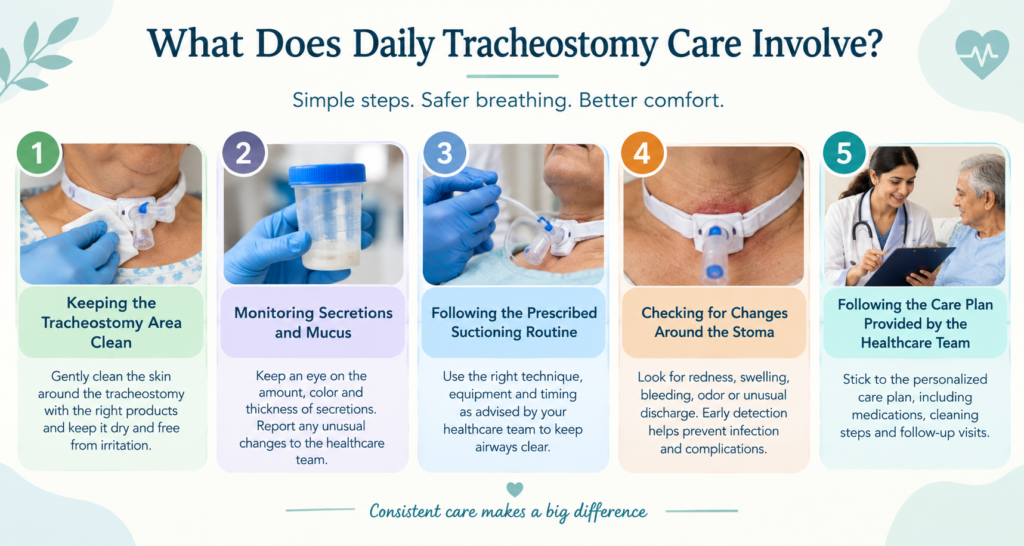
Daily care should follow the patient’s individualized discharge plan. General online information should never replace hands-on clinical training.
1. Keeping the Tracheostomy Area Clean
The skin around the stoma should be cared for according to the instructions provided by the healthcare team. Caregivers should watch for increasing redness, swelling, unusual discharge, skin irritation, or other changes.
Good hand hygiene is important before and during routine care. Dressing changes and cleaning should follow the technique taught by the healthcare professional.
2. Monitoring Secretions and Mucus
Caregivers should observe respiratory secretions and note changes in their amount, thickness, color, or difficulty clearing them. A significant change from the patient’s normal pattern may require professional assessment.
3. Following the Prescribed Suctioning Routine
Some patients require suctioning to help clear airway secretions. The technique, frequency, and equipment should be based on the patient’s prescribed care plan.
Caregivers should not change the suctioning routine or attempt unfamiliar techniques without appropriate professional instruction.
4. Checking for Changes Around the Stoma
Regularly observe the stoma and surrounding skin as instructed. Unusual bleeding, swelling, redness, discharge, or skin breakdown should be reported to the healthcare team.
5. Following the Care Plan Provided by the Healthcare Team
The discharge plan serves as the basis for home care of a tracheostomy tube. It should be followed as a guide for the care, equipment, medications, follow-up, and response to potential complications.
In case of any uncertainty, the family should ask for clarification instead of guessing about the instructions.
Also read: Patient Attendant vs. Nurse in Jaipur
How Can Caregivers Manage Mucus and Secretions?
Mucus can become a problem for tracheostomy patients as their airways are not the same as before the surgery. Difficult-to-clear secretions can obstruct the airways.
The healthcare provider can advise on methods to remove such obstructive secretions, for instance, by adequate fluid intake, providing moisture, suction, or other ways. However, patients should only use recommended techniques and means.
Caregivers should monitor:
- Amount of secretions
- Color or appearance
- Thickness
- Difficulty clearing mucus
- Changes in breathing associated with secretions
A sudden increase, significant change, or difficulty clearing secretions should be discussed with a healthcare professional, particularly when accompanied by breathing problems.
What Warning Signs Should Families Watch For?
Recognizing warning signs is an important part of tracheostomy care at home. Families should understand the patient’s usual condition and watch for changes.
Important warning signs include:
- Difficulty breathing
- Increasing respiratory distress
- Suspected tube blockage
- Unusual or significant bleeding
- Signs of infection around the stoma
- Significant changes in secretions
- Accidental tube displacement
- Sudden deterioration in the patient’s condition
When Is Emergency Medical Help Needed?
The discharge of a tracheostomy patient does not mean an end to the road; rather it is a shift to another level of care. Preparations, hygienic maintenance, monitoring as well as thorough communication is key in ensuring successful care of such patients at home.
Family members need to comply with the developed plan of care, have proper material readiness, carry out proper monitoring of secretion and breathing and learn when to seek professional assistance. In cases where the care provided is complex or the caregiver is not adequately trained, professional nurses may offer such services as a means of supplementing family care.
With proper preparations and professional support, the experience of home care for tracheostomy patients can be made more organized and efficient.
Read more: Why Choose HomeCare24 for Home Care Services in India
How Can Families Reduce the Risk of Tracheostomy Complications?
Consistent care and preparation can help families manage tracheostomy patients more safely.
Important steps include:
- Follow the prescribed care plan.
- Maintain appropriate hand and equipment hygiene.
- Keep essential supplies available.
- Monitor breathing and secretions.
- Make sure caregivers understand their responsibilities.
- Keep emergency contacts accessible.
- Never change the tube or treatment without professional guidance.
- Maintain scheduled follow-up appointments.
- Arrange professional support when the patient’s needs exceed family training or availability.
When Does a Tracheostomy Patient Need Professional Home Nursing Care?
Professional tracheostomy care nursing can be valuable when a patient requires regular monitoring or has complex medical needs.
Professional support may be appropriate when:
- The patient requires frequent monitoring.
- Family members are not adequately trained.
- Regular suctioning or airway support is prescribed.
- The patient has complex medical needs.
- Family caregivers cannot provide continuous care.
- The patient is recovering after a prolonged hospital stay.
Professional nursing can work alongside family involvement. Nurses can provide appropriate clinical support while family members continue helping with comfort, communication, and everyday needs.
This can be particularly helpful as part of post-hospitalization care, when families are adjusting to new responsibilities after discharge.
Also read: Bringing a Patient Home From the Hospital
Trained Nurse vs. Family Caregiver for Tracheostomy Care
Professional nursing and family caregiving do not need to be an either-or choice. They can complement each other.
| Care Need | Trained Nurse | Family Caregiver |
| Training | Professional clinical training | Patient-specific training is required |
| Monitoring | Provides trained clinical observation | Observes and reports changes |
| Suctioning | Can provide prescribed support within training | Should only perform after proper instruction |
| Warning signs | Trained to identify concerning changes | Can identify changes and seek help |
| Emergency readiness | Follows established clinical plans | Knows emergency instructions and contacts |
| Family involvement | Guides and supports caregivers | Provides comfort and daily support |
The appropriate arrangement depends on the patient’s condition, care plan, family capability, and availability of professional support.
A Simple Tracheostomy Care Checklist for Families
- Required supplies are available and organized.
- The prescribed care routine is followed.
- Secretions are monitored for significant changes.
- The stoma is checked as instructed.
- The patient’s breathing is observed.
- Emergency contacts are easily accessible.
- Follow-up appointments are maintained.
- Professional support is arranged when required.
This checklist is only a reminder tool and should not replace individualized medical instructions.
How HomeCare24 Supports Tracheostomy Patients at Home
HomeCare24 provides professional support for patients who require ongoing care after hospital discharge. Depending on the patient’s needs and prescribed care plan, support can include tracheostomy care at home, professional health care assistance, patient monitoring, suctioning support, and post-hospitalization care.
Families can also receive support while adapting to the patient’s home-care routine. For dedicated assistance, visit HomeCare24 to learn more.
Making Tracheostomy Care at Home Safer
The discharge of a tracheostomy patient does not mean an end to the road; rather it is a shift to another level of care. Preparations, hygienic maintenance, monitoring as well as thorough communication is key in ensuring successful care of such patients at home.
Family members need to comply with the developed plan of care, have proper material readiness, carry out proper monitoring of secretion and breathing and learn when to seek professional assistance. In cases where the care provided is complex or the caregiver is not adequately trained, professional nurses may offer such services as a means of supplementing family care.
With proper preparations and professional support, the experience of home care for tracheostomy patients can be made more organized and efficient.
Frequently Asked Questions About Tracheostomy Care at Home
1. Can a tracheostomy patient be cared for at home?
Yes. Some stable tracheostomy patients can receive care at home when the healthcare team has provided an appropriate care plan and caregivers understand the required responsibilities, equipment, and warning signs.
2. How often does a tracheostomy need care?
The frequency varies according to the patient’s condition, tube type, secretion levels, and prescribed care plan. Families should follow the schedule provided by the healthcare team rather than using a standard routine.
3. What supplies are needed for tracheostomy care at home?
Supplies depend on the patient’s needs and may include suction equipment, appropriate cleaning materials, dressings, replacement equipment, and emergency supplies recommended by the healthcare team.
4. When should a family call a doctor for a tracheostomy patient?
Contact the healthcare provider concerning changes such as unusual secretions, new redness or discharge around the stoma, or difficulty clearing mucus. Severe breathing difficulty, significant bleeding, suspected airway blockage, or sudden deterioration requires emergency medical attention.
5. Does a tracheostomy patient need a nurse at home?
Not every patient requires continuous nursing care. However, professional nursing may be appropriate when the patient needs frequent monitoring, suctioning support, complex care, or when family caregivers cannot provide the required level of support.
6. Can family members perform tracheostomy care?
Family members can participate after receiving patient-specific training from the healthcare team. They should only perform tasks they have been properly taught and should seek professional guidance when unsure about a procedure or change in the patient’s condition.